
By the author · Updated November 2, 2026
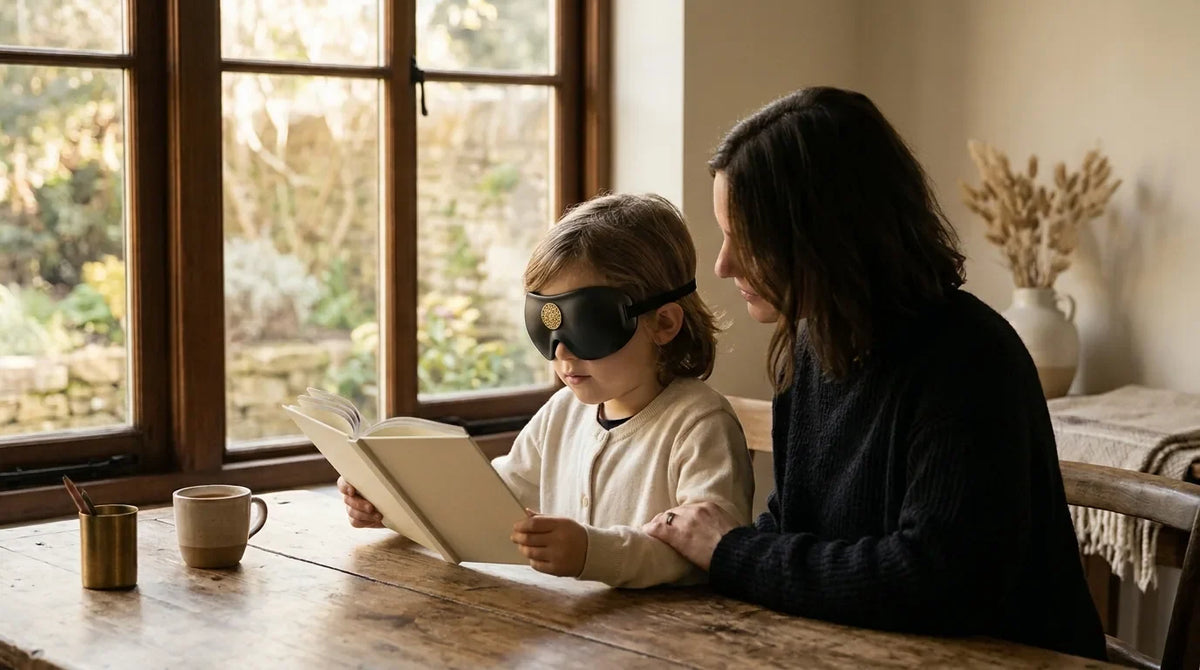
A child sits with an opaque mask over the eyes. You hold up a card. After a moment the child says: “Red.” It is the kind of moment that makes a parent lean closer, and never forget it.
This experience goes by many names: closed-eye vision, eyeless sight, blindfold reading, seeing without eyes, mindsight. Families around the world describe it, online communities talk about it every day, and children’s workshops have appeared from India to Spain to North America. This is a warm introduction for parents who have just heard about it and want to understand what it is, where it comes from, and how to begin. New to the terms? Each key word links to our glossary, and the whole subject is gathered in the complete guide to closed-eye vision.
In short
- Closed-eye vision is the name for perceiving colors, shapes, numbers or letters while the eyes are completely covered by a lightproof mask.
- The idea has been written about for more than a century, and families around the world describe it today.
- Children take to it naturally. With play, calm and a truly lightproof mask, the journey can begin at home.
What people describe
People describe perceiving colors, shapes, numbers and letters while their eyes are covered by a lightproof mask. Many describe it as an image that “opens”, sometimes as a small point of light that slowly grows, sometimes as a scene that appears all at once. Children often describe it with wonderful simplicity, as if it were the most natural thing in the world, and adults describe the first moment with delight.

The book Seeing Beyond Matter was written by an author who practiced this with children and with adults, and built from that hands-on experience a complete and practical guide for every family that feels the pull to explore it.
One experience, many names
If you search the topic, you will meet a family of terms. Here is what they usually mean:
- Closed-eye vision and seeing without eyes: everyday names for perceiving something while the eyes are covered or closed.
- Eyeless sight: the English title of a 1924 book by the French writer Jules Romains (see below), now used as a general term.
- Blindfold reading and blindfold sight: the same idea in the context of reading text or identifying cards while blindfolded.
- Mindsight: a popular name used by online communities and training programs. (It is also used in psychology with a different meaning, so check the context.)
- Extra-retinal vision and paroptic sense: the terms Romains used for a perception that does not go through the retina.
- Dermo-optical perception (“skin vision”): the name given to the 1960s accounts of perceiving colors through the fingertips.
- Midbrain activation: a commercial label used by some children’s programs. We look at it separately in our guide to choosing between courses, workshops and a home kit.
An old question, a growing wave
The idea is not new. In 1920 the French writer and poet Jules Romains published La vision extra-rétinienne et le sens paroptique, a study of what he believed was a perception independent of the eyes. It appeared in English in 1924 as Eyeless Sight, translated by C. K. Ogden, and the volume is still catalogued in major libraries such as the Wellcome Collection.
In the early 1960s, reports about Rosa Kuleshova, a young woman from the Soviet city of Nizhny Tagil who was said to identify colors with her fingertips, drew international attention, and in 1964 a Life magazine reporter wrote about meeting her in Moscow. For a century the question has kept returning in different forms: do we perceive more than we have been taught? Today, more and more families are answering it at home. For the primary sources, see our library of rarely read sources.
Before you begin at home

Every journey at home begins with three things:
- A truly lightproof mask that blocks all light, including around the nose, and rests on the face without pressing on the eyes. We explain how to check this in 6 things to check in a blindfold training mask.
- The Illustrated Booklet, 44 full-color pages made for children, the visual companion that invites the whole family in.
- The Book, which holds the know-how: the complete practical path.
The 12 Color Cards and a calm room complete the picture. Then bring the right spirit:
- Calm and play. It should feel like a game you share, a quiet and happy moment together.
- Persistence and focus. The key is correct practice, patience, calm and the belief that it is possible. Every child moves at a personal pace, and that is part of the journey.
- Enjoy the journey. Let the experience unfold for your child, without turning it into a performance for others.
- Stop when it stops being fun. If a child is uncomfortable, take the mask off and do something else.
Frequently asked questions
What is closed-eye vision?
It is the name people give to perceiving colors, shapes, numbers or letters while the eyes are fully covered. People around the world describe it, and many families share vivid accounts. The Seeing Beyond Matter kit gives you the complete guide and every tool in one box, so your family can explore it together.
What is blindfold reading?
Reading text, or naming colors and cards, while the eyes are covered. It is the same idea as closed-eye vision, seen through the practice of reading. See the complete guide for how the terms fit together.
Can children do it?
Children often take to it naturally. They bring play, imagination and no preconceptions, and they tend to describe what they experience with beautiful simplicity. The book is written for parents and for every curious adult, so the whole family can take part.
How do I know a mask is truly lightproof?
A good training mask closes around the nose, gives true darkness, and rests on the face without pressing on the eyes. A sleep mask is made for comfort and often lets light in. Our checklist, 6 things to check in a blindfold training mask, shows how to test one at home.
Is it the same as midbrain activation or opening the third eye?
They belong to the same family of searches. “Midbrain activation” is a commercial label, and the “third eye” is a spiritual and historical idea with a long history. For the history of the “third eye” and the pineal gland, see our illustrated history of the pineal gland.
Is it safe?
The kit is for personal development and is not a medical treatment or advice. Choose a mask that does not press on the eyes, keep sessions calm and short, stop if a child is uncomfortable, and speak with a doctor about any concern regarding eyes or health.
What is in the kit?
The Seeing Beyond Matter kit contains the hardcover Book, a 44-page full-color Illustrated Booklet, a lightproof Practice Mask and 12 Color Cards, in a magnetic box, together with a playlist of frequency music on our website. The Book is available in English and Hebrew editions.
Keep exploring
- Closed-eye vision: the complete guide
- What you see when you close your eyes
- What makes a good blindfold training mask
- A gift unlike any other for curious children
- The full glossary and the questions everyone asks
Where to go next
The full path is in the book Seeing Beyond Matter by its author, which comes inside the Seeing Beyond Matter kit together with an Illustrated Booklet, a Practice Mask and 12 Color Cards. Imagine the first time your child says it. You can also read the author’s story, the facts page and the glossary.
The kit is for personal development and is not medical treatment or advice.