
By the author · Updated November 4, 2026
A regular sleep mask is made for sleeping, not for practice. If you are looking for a blindfold training mask for a child or for yourself, these are the six things that matter, and a three-minute test you can run at home before you trust any mask, including ours. New to the subject? Start with the complete guide to closed-eye vision or the glossary entry on blindfold reading.
In short
- A good training mask blocks all light, especially around the nose, where most masks leak.
- Deep eye cavities keep the mask off the eyelids, so the eyes can open and close freely inside.
- A rigid front keeps the shape and the darkness, soft foam where it touches the face keeps it comfortable, and an adjustable strap makes it fit everyone.
- To use a blindfold correctly: fit it so the cavities sit over the eyes and the nose bridge is sealed, sit comfortably in a quiet place, and take it off slowly if anything feels uncomfortable.
- The mask creates the darkness; the Book, the Booklet and the Color Cards turn it into a journey.
1. Total darkness
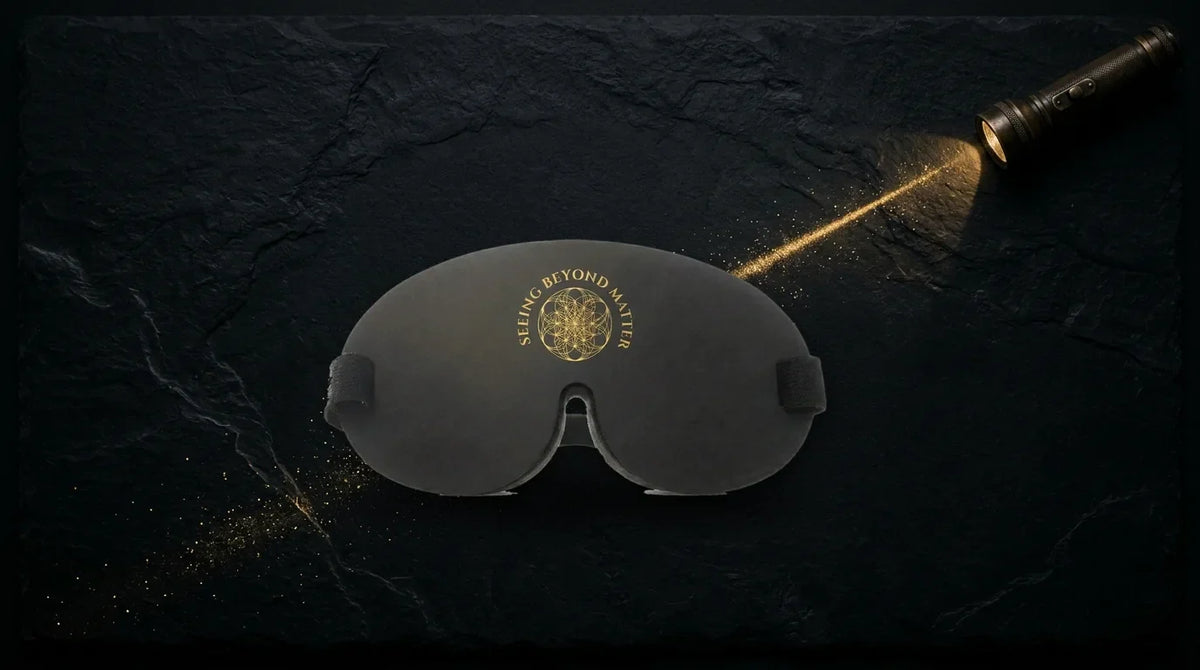
The mask must block all light, including around the nose, where most masks leak. Test it in a bright room: with the mask on and eyes open, you should see complete black. For a stricter check, ask someone to shine a bright flashlight slowly around the edges and the nose bridge while you wear it. Any flicker of light means the mask is not suitable for practice.
This is not a detail. Practice begins in true darkness, so even a thin gap spoils the experience. It is worth checking carefully, and it is a check you can do yourself in minutes.
2. No pressure on the eyes
A flat mask presses on the eyelids. A contoured mask with deep eye cavities lets the eyes open and close freely inside, which is far more comfortable over time. Look for the depth of the cavity rather than only the width of the mask.
3. A soft inner lining and a rigid front
Soft 3D PE foam where the mask touches the face rests gently and seals out light without discomfort. A rigid front keeps the shape and the darkness, so the mask does not collapse onto the eyes when you turn your head.
4. A strap that fits every head
An adjustable elastic strap should fit a young child and an adult equally well, so the whole family can use it. Check that tightening it for a small head does not lift the mask away from the face at the nose.
5. Easy to care for
Durable PE foam is easy to look after, which matters when several people share one mask.
6. A mask that comes with a path
A mask alone does not tell you what to do with it. The mask is the tool; the guidance is what turns it into practice.
A three-minute test you can do at home

- Bright room test. Put the mask on with your eyes open in a well-lit room. You should see black.
- Flashlight test. Ask someone to sweep a flashlight around the edges and across the nose bridge.
- Movement test. Turn your head, frown and smile. The mask should not shift or let light in.
- Fit test. Adjust the strap for each person who will use it, and repeat the first two tests each time.
How to use a blindfold correctly
Once the mask passes the tests, using it well is simple:
- Fit it first. Place the eye cavities directly over the eyes, settle the nose bridge, and adjust the strap until the mask is snug but not tight. Move any hair out from under the edges.
- Choose a calm place. Sit comfortably somewhere quiet and familiar. With a child, an adult stays close by.
- Let the eyes be comfortable. Inside the cavities the eyes can stay open or closed, whichever feels natural. Never press the mask against the eyes.
- Keep sessions short at first. If anything feels uncomfortable, take the mask off at once.
- Take it off slowly. Lift the mask gently and give the eyes a moment to adjust to the light before you look around.
- Look after it. Wipe the foam and let the mask dry. Re-check the fit whenever a different person uses it.
The mask only makes the darkness. What to do inside that darkness is what the Book and the kit are for.
How common mask types compare
| Feature | Flat fabric mask | Contoured foam mask | Seeing Beyond Matter Practice Mask |
|---|---|---|---|
| Eye cavities | None | Usually yes | Yes, 1.8 cm deep |
| Front | Soft fabric | Varies | Rigid |
| Where it touches the face | Fabric | Foam | Soft 3D PE foam |
| Strap | Elastic, often fixed | Varies | Adjustable elastic |
| Comes with a guide | No | Rarely | Yes, inside the kit |
Our mask
The Seeing Beyond Matter Practice Mask has a rigid black front that lets no light through, soft 3D PE foam where it touches the face, deep eye cavities and an adjustable elastic strap, with the gold Seeing Beyond Matter mandala on the front.
- Outer size: 21.7 × 10 cm
- Eye cavity: 18.5 × 9.5 cm, 1.8 cm deep
- Weight: 25.4 g
- Strap: adjustable elastic
It comes inside the Seeing Beyond Matter kit, together with the Book, a 44-page Illustrated Booklet and 12 Color Cards, and it is also available on its own as the Seeing Beyond Matter Practice Mask. Comparing with a specific brand? See our comparison page.
The mask is not a medical device or treatment. It is a practice accessory.
Frequently asked questions
How do I use a blindfold correctly?
Place the eye cavities directly over your eyes, seal the nose bridge and adjust the strap until it is snug but not tight. Sit comfortably in a quiet place, keep sessions short at first, and take the mask off slowly, letting your eyes adjust to the light.
Can children and adults use the same mask?
Yes. The adjustable elastic strap is designed to fit a range of head sizes. Re-run the light tests each time you change the fit.
Why not simply use a sleep mask?
Sleep masks are designed for sleeping. Many are flat and can press on the eyelids or leak light at the nose, which is the opposite of what a careful practice needs.
What does the mask do?
It removes the light, completely and comfortably, so the practice can begin in true darkness. Inside the kit, the Book, the Illustrated Booklet and the Color Cards guide the journey from there.
Is the mask sold separately?
Yes. It is part of the kit and also available on its own. The kit adds the Book, the Illustrated Booklet and the Color Cards, so the mask comes with a path.
New to the whole topic?
Start with a parent’s introduction to closed-eye vision, or browse the glossary.