
By the author · Updated October 30, 2026
Few organs in the human body carry as much wonder as the pineal gland. For more than two thousand years anatomists, philosophers and mystics have asked what this tiny structure in the middle of the brain is for. Some called it a valve for thought, one called it the seat of the soul, and many traditions connect it with the “third eye”. This guide follows the story from ancient Greece to modern laboratories, and keeps one simple order: what is documented is told as history, and what has been handed down is told as tradition.
New to the terms? Each key word below links to our glossary, and the sources are collected in our library of rarely read sources.
In short
- The pineal gland is a small, pine-cone-shaped gland near the center of the brain. In humans it is roughly 7–8 mm long and weighs about 0.15 g.
- Its first established function was discovered only in 1958, when a team led by Aaron Lerner isolated melatonin from it. Melatonin is produced mostly during the dark part of the day, and the gland works as a kind of biological clock.
- In some reptiles, such as the tuatara and many lizards, a related structure forms a real parietal eye with a lens and a simplified retina. That is where the biological idea of a “third eye” comes from.
- The “third eye” as a spiritual idea is a separate, much older tradition, and it is the one people most often mean when they speak of inner sight.
What the pineal gland is
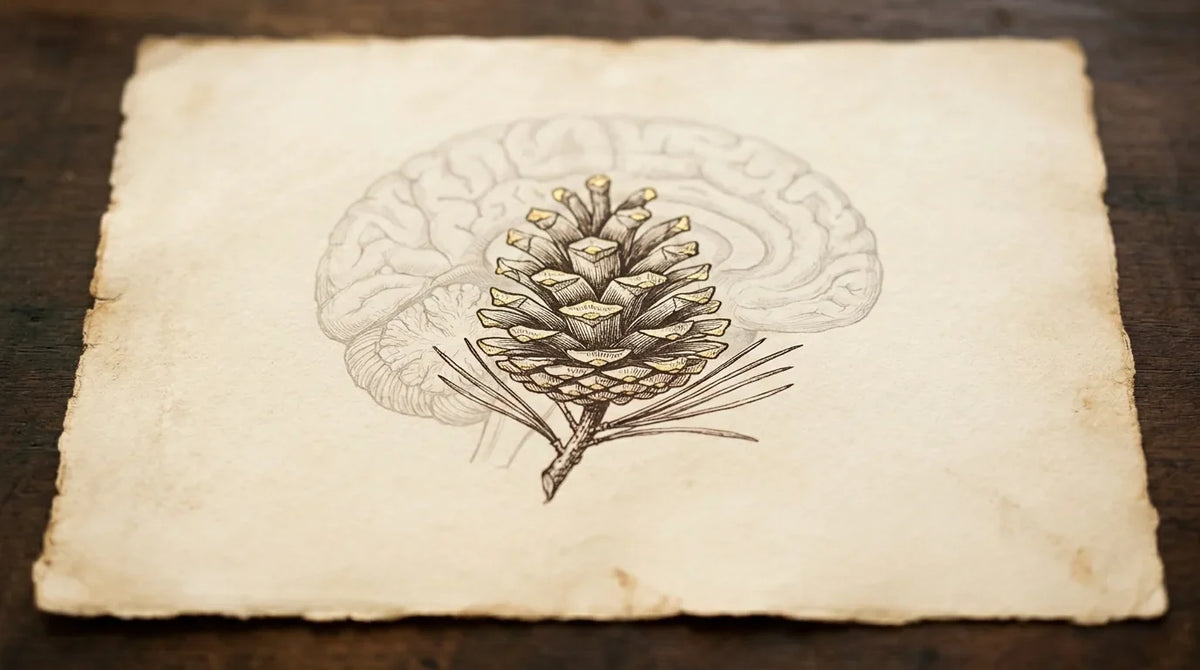
The pineal gland, also called the pineal body or conarium, sits deep in the brain near its midline, in a region called the epithalamus. Its name comes from its resemblance to a pine cone. In adults it often develops small calcium deposits, sometimes nicknamed “brain sand”, which make it visible on X-ray images and have long made it a landmark for radiologists.

The modern picture, described in a review in the journal Hektoen International, is of a gland that translates information about light and darkness into a hormonal signal. Most melatonin in mammals is made in the pineal gland, and its output peaks during the dark hours regardless of whether an animal is active by day or by night.
A timeline from ancient Greece to today
| When | Who | What was proposed or found |
|---|---|---|
| Ancient Egypt | Symbolism | The Eye of Horus is a symbol of protection and prosperity. Some writers link it to the pineal gland. |
| c. 3rd century BCE | Herophilus | Described the structure and, as later writers report, suggested it acts as a valve controlling the flow of “thought” through the brain’s ventricles. |
| 2nd century CE | Galen | Gave the first detailed written description. He rejected the valve idea and regarded it as an ordinary structure related to the brain’s veins. |
| 1649 and 1664 | René Descartes | In The Passions of the Soul and Treatise of Man, named it the principal seat of the soul, the point where mind and body meet. |
| 17th–19th centuries | Anatomists | Critics noted that animals, which Descartes thought lacked a rational soul, have the gland too. In the 19th century many treated it as a rudimentary leftover. |
| 1958 | Aaron Lerner and colleagues | Isolated melatonin from cattle pineal glands, giving the gland its first established biological role. |
| Mid-20th century onward | Researchers | Linked the gland to circadian rhythms and showed that light information reaches it through the eyes in mammals. |
| 2025 | Romero and de Souza | A study in Genome Biology and Evolution reported an ancient light-sensing gene, named lepidopsin, found in the tuatara and most lizard groups, and found that parietal eyes and pineal light-sensing genes go together. |
The ancient story: valve, spirit and soul
The earliest Greek anatomists believed the brain, not the heart, was the seat of the mind. Herophilus, working in Alexandria around the third century BCE, is credited with describing the pineal and imagining that it controlled the flow of a mental “pneuma” between the brain’s fluid-filled chambers. Galen, in the second century CE, described it more carefully, disagreed with the valve theory and treated it as a supporting structure. His views held for well over a thousand years.
In the seventeenth century René Descartes revived the gland’s mystery. He reasoned that the soul must meet the body at a single point, since the brain’s other structures come in pairs, and he picked the pineal gland because it is unpaired and central. His proposal became one of the most influential ideas in the history of the philosophy of mind. If you want the philosophical details, the Stanford Encyclopedia of Philosophy entry on Descartes and the pineal gland is the standard reference.
The biological “third eye”
The phrase “third eye” has a precise meaning in biology. Many lizards and the New Zealand tuatara have a parietal eye on the top of the head, often visible as a small spot on a head scale. It has a lens and a simplified retina connected to the brain, and it reports light and darkness. It is thought to help with daily rhythms and orientation. A feature in Science Focus explains how this has changed ideas about the early evolution of the retina, and the 2025 paper in Genome Biology and Evolution reports the ancient opsin gene mentioned in the timeline.
In mammals, including humans, the pineal gland no longer sits under the skull roof. It receives information about light by a relay from the eyes. That is the biological story, and it is a different story from the spiritual one below.
The spiritual “third eye”
In Indian traditions, the “third eye” is associated with the ajna or brow chakra, the energy center said to lie between the eyebrows and to relate to insight and intuition. In the late nineteenth century Helena Blavatsky and the Theosophists proposed that the pineal gland was the remnant of a literal third eye possessed by early humans. Later esoteric writers extended the idea in many directions, and today you will find many writings about awakening and caring for the pineal gland.
These are traditions and experiences that many people find deeply meaningful, and they are told here the way the traditions themselves tell them. The psychiatrist Rick Strassman has put forward the hypothesis that the pineal might produce the compound DMT. This guide is history, not health advice, and nothing in it is a recommendation to change diet, take supplements or follow any regimen.
Where this meets Seeing Beyond Matter
Anyone who explores inner sight meets the pineal gland sooner or later, because for centuries it has been the place where anatomy, symbol and wonder come together. We tell its history because it is fascinating, and because it frames a question that has followed humanity for thousands of years: is there more to our perception than we were taught?
The practical journey itself lives in the book Seeing Beyond Matter, inside the complete kit. This history is a map of ideas, from anatomy to symbol to tradition, for curious readers.
For questions about sleep, melatonin or any medical concern, speak with a doctor.
A short reading list
- Galen, On the Usefulness of the Parts of the Body (De usu partium), second century CE.
- René Descartes, The Passions of the Soul (1649) and Treatise of Man (L’Homme, published posthumously in 1664).
- Aaron B. Lerner and colleagues, “Isolation of melatonin, the pineal gland factor that lightens melanocytes”, Journal of the American Chemical Society, 1958.
- Gert-Jan Lokhorst, “Descartes and the Pineal Gland”, Stanford Encyclopedia of Philosophy.
- The encyclopedia overview of the history of the pineal gland.
- Our library of rarely read sources, with a note on each one.
Looking for a term? Browse the full glossary of closed-eye vision, intuition and the pineal gland.
Frequently asked questions
What is the pineal gland?
A small pine-cone-shaped gland near the center of the brain that produces melatonin and helps the body follow the rhythm of light and dark.
Why is the pineal gland called the third eye?
In some reptiles, a related structure forms a true parietal “third eye” with a lens and a simplified retina. In spiritual traditions, the “third eye” is an inner organ of insight, associated with the center of the forehead and with the pineal gland.
Why did Descartes call it the seat of the soul?
Because he believed the soul had to interact with the body at one point, and the pineal gland is a single, central structure rather than one of a pair.
What do traditions say about awakening the pineal gland?
Many traditions and modern writers describe practices for awakening the “third eye”, and it is a rich field to read about. This guide stays with the history and offers no health advice or instructions.
Where does closed-eye vision fit in?
It is a related topic of wonder. People describe perceiving colors and shapes with their eyes covered. Read a parent’s introduction to closed-eye vision for an overview, or see the glossary entry.
Keep exploring
- Closed-eye vision: the complete guide
- A library of rarely read sources
- What you see when you close your eyes
- The full glossary and the questions everyone asks
This article is for general education and is not medical advice.